





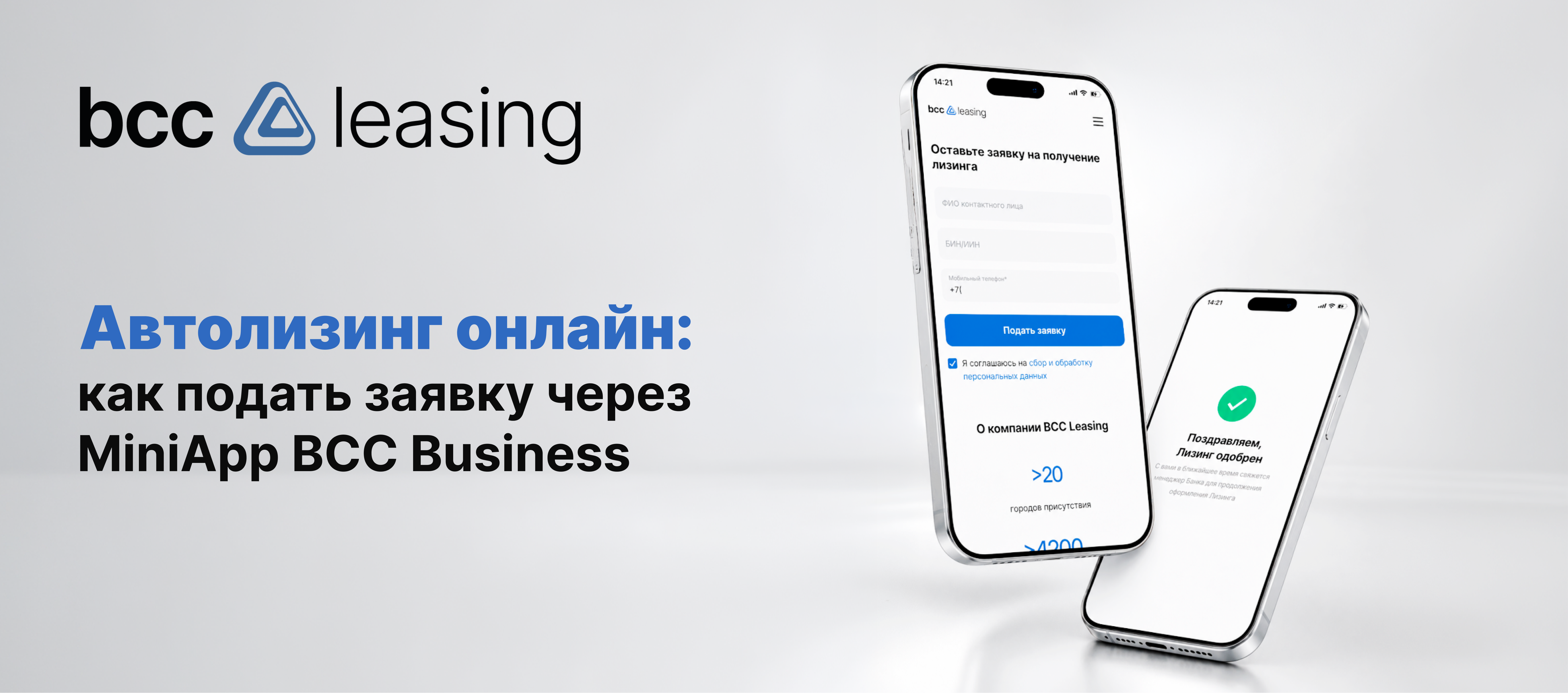
How to get leasing in Kazakhstan?
In short, you need to choose the asset you want to lease, submit an application to a leasing company, complete the review process, and sign the lease agreement. Once the agreement is finalized, the asset is transferred to you for use, and the lease payments are spread over the agreed term.
In practice, the process is straightforward, especially if you know in advance what steps to expect and what leasing companies consider when reviewing an application. Let's take a closer look at how Individual Entrepreneurs (IE) and LLPs can obtain leasing in Kazakhstan with minimal hassle.
- What You Need to Apply
- Documents Required for IE
- Documents Required for LLPs
- Is Collateral or a Guarantee Required?
- Step-by-Step Application Process
- Step 1. Choose the Asset
- Step 2. Submit an Application
- Step 3. Review and Approval
- Step 4. Sign the Agreement
- Step 5. Pay the Initial Contribution and Receive the Asset
- Application Process
- Approval Criteria
- Credit History and Tax Compliance
- Business Financial Capacity
- Initial Contribution
- Online Application
- How Is Leasing Different from a Loan?
What Documents Are Required and What Requirements Apply to Lessees in Kazakhstan?
To obtain leasing, a business needs to demonstrate three things:
- that the company or individual entrepreneur is actively operating;
that it generates sufficient cash flow to meet lease payment obligations;
that the selected asset is required for a legitimate business purpose.
In practice, leasing companies evaluate not only the legal status of the business but also its financial discipline, cash flow, and the completeness of the submitted documentation.
What Documents Does a Leasing Company Require from an IE?
When applying for leasing, an IE is generally required to provide registration details, tax records, and proof of business turnover.
Standard application package includes:
entrepreneur's identity document;
certificate or registration document of the IE;
bank statement showing business turnover for the past 12 months;
tax returns for the latest reporting periods;
financial or management reports, if maintained;
completed application form;
documents relating to the asset to be leased. (commercial proposal when leasing machinery, equipment, motor vehicles, or special-purpose equipment; an appraisal report when leasing real estate)
Where necessary, the leasing company may also request agreements with key customers or suppliers.
What Documents Does a Leasing Company Require from LLP?
For LLPs in Kazakhstan, the documentation package is more comprehensive because, in addition to assessing the company's financial position, the leasing company must verify the authority of the company's director and the company's legal status.
Typically, an LLP provides:
company's charter and registration documents;
appointment order or resolution appointing the director;
director's identity document;
company's seal and authorized signature, where used in business operations;
bank statement showing business turnover for the past 12 months;
financial statements;
completed application form;
documents relating to the asset to be leased (commercial proposal when leasing machinery, equipment, motor vehicles, or special-purpose equipment; appraisal report when leasing real estate)
Information regarding existing contracts and obligations may also be requested.
Is Additional Security Required?
In most cases, no, because the leased asset itself serves as collateral.
This is one of leasing's key advantages. Unlike a traditional loan, businesses generally do not need to provide additional collateral or obtain guarantors, making leasing easier to arrange than conventional bank financing. However, for certain transactions, the leasing company may require additional security if the nature of the project warrants it.
How Does the Leasing Process from Application to Getting Equipment or Vehicle Work?
The leasing process typically consists of five main stages: selecting the asset, submitting an application, document review, signing the lease agreement, and delivery of the leased asset.
Step 1. Choose the Asset
The first step is deciding what your business needs, whether it's a passenger vehicle, commercial transport, special-purpose equipment, machinery, or another type of asset. It's important to determine in advance how the asset will be used, what performance requirements it must meet, and whether its cost aligns with your business's financial capabilities.
Step 2. Submit an Application
Once you've selected the asset, submit your application to the leasing company. At BCC Leasing, for example, applications can be submitted online through the company's website. At this stage, the basic transaction parameters are confirmed, including who the lessee will be, which asset is being leased, its purchase price, whether a payment schedule for a specific lease term is required, and the amount of the initial contribution the customer is prepared to make.
Step 3. Review and Approval
Once the application has been received, the leasing company begins reviewing the submitted documents. For Digital Leasing, a decision may be made in as little as 10 minutes. For business financial leasing, the full review process generally takes from seven business days.
Step 4. Sign the Agreement
This is one of the most important stages of the leasing process, as it establishes all key terms of the transaction, including the value of the asset, the initial contribution, the financing term, the payment schedule, the purchase option, and the rights and obligations of the parties. Before signing the agreement, carefully review the financing rate, monthly payments, early purchase terms, insurance and registration requirements, and any additional costs that may apply.
What are the key terms specified in the lease agreement?
The agreement sets out all financial and legal terms of the transaction, including:
- financing term;
- interest rate and total financing cost;
- payment schedule;
- amount of the initial contribution;
- purchase option terms.
The BCC Leasing website provides the key parameters of its leasing programs, giving customers a clear understanding of the basic financing terms.
Step 5. Pay the Initial Contribution and Receive the Asset
Once the lease agreement has been signed, the customer pays the initial contribution, and the transaction proceeds to implementation. The leased asset is then transferred to the customer, allowing it to be put into operation immediately.
How Long Does It Take to Obtain Leasing in Kazakhstan?
The processing time depends on the type of asset, the completeness of the documentation, and the structure of the transaction. In general, approval may take as little as 10 minutes for vehicle leasing and from one week for financial leasing.
The best way to speed up the process is to prepare the required documents in advance, select the asset you intend to lease, and determine the amount of the initial contribution your business is prepared to make.
Why Might a Leasing Application Be Declined and How Can You Improve Your Chances of Approval?
Applications are most commonly declined due to financial risks, such as insufficient business turnover, excessive debt, deficiencies in financial reporting, or an unclear business purpose for acquiring the asset.
If a company or individual entrepreneur operates inconsistently, reports little or no business activity, or already has a significant debt burden, the likelihood of approval may decrease. Leasing companies also assess the transparency of the business by reviewing whether financial reports are up to date, tax obligations are properly fulfilled, and cash inflows can be verified.
To improve your chances of approval, it is advisable to:
- ensure that your financial reporting is accurate and up to date;
- prepare bank statements demonstrating consistent business turnover;
- reduce excessive debt, where possible;
- select an asset appropriate for the size and needs of your business;
- and clearly explain how the asset will be used and how lease payments will be funded.
The clearer your business model is to the leasing company, the easier it is to obtain financing on favorable terms.
Is Credit History Checked When Applying for Leasing?
Yes. Credit history is typically reviewed because it demonstrates how a customer has met previous financial obligations.
However, leasing approval is not always as heavily dependent on credit history as a traditional bank loan. A few minor delays in the past do not necessarily result in an automatic rejection. What matters most is the overall financial picture, whether there is a pattern of overdue obligations, how the business is performing today, and whether it consistently meets its tax obligations. Tax compliance is also an important consideration. Outstanding tax liabilities, deficiencies in reporting, or repeated violations may negatively affect the assessment of the applicant's reliability.
How Is a Company's Financial Capacity Assessed?
Financial capacity is evaluated based on business turnover, the consistency of cash inflows, and the relationship between the proposed lease payments and the company's existing financial commitments.
The leasing company assesses whether the business can comfortably meet its payment obligations as part of its normal operations. If sufficient funds remain after covering current expenses, loan repayments, and other obligations, the likelihood of approval increases.
What Is the Initial Contribution for Leasing in Kazakhstan?
In most cases, the initial contribution ranges from 10% to 50% of the asset value.
The exact amount depends on the value of the asset, the lease term, and the customer's financial position.
Can I Apply for Leasing Online Without Visiting an Office?
Yes. Now most of stages can be completed online, including submitting an application, providing documents, and agreeing on the terms.
This simplifies the process and significantly reduces the time required to complete the transaction.
How Is Leasing Different from a Business Loan?
Leasing is generally easier to obtain, faster to arrange, and does not require separate collateral.
Key advantages:
- leased asset itself serves as collateral;
- higher approval potential;
- more flexible financing terms;
- potential tax benefits.
To understand leasing more quickly, start with a calculation, it is the easiest way to see which terms are available for your business.
Иногда возможно в рамках отдельных программ, но чаще требуется минимальный аванс.
Как правило, нет - компания должна подтвердить обороты и деятельность.
Да, такая возможность обычно предусмотрена договором.
Возможно, но шансы выше у компаний с историей от 6–12 месяцев.